Between Fjord and Lab
Insights into Current Research and Collaboration Between Germany and Denmark
01.06.2026
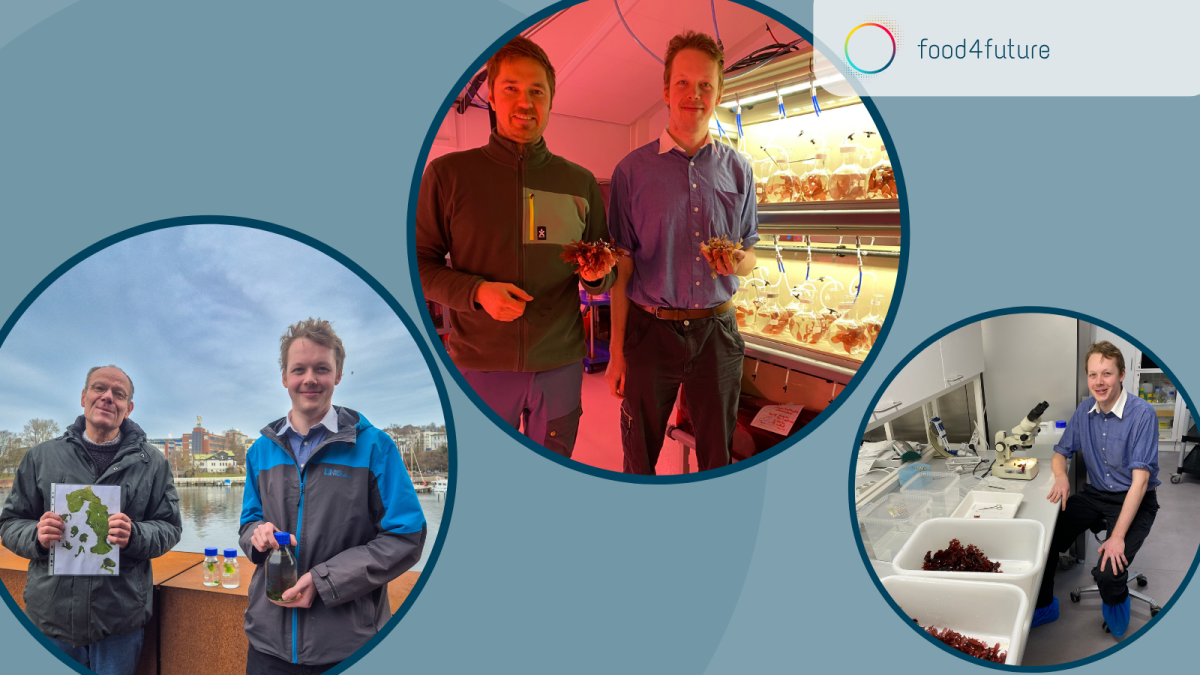
Stopover in Kiel: Discussion on Algae Research and Genetics
The first stop on the trip was Kiel, where algae samples were handed over to GEOMAR. A key focus was an exchange with Dr. Florian Weinberger, who specializes in DNA barcoding for macroalgae. This method is particularly relevant for the genus Ulva, as its species often look very similar. However, genetic analyses can be used to precisely determine which species are actually present and whether certain strains become dominant during cultivation.
In addition, ongoing research projects in Kiel were discussed, such as those focusing on the establishment of Fucus species in the context of carbon sequestration. These brown algae are of interest not only as potential carbon sinks but also because of their constituents, particularly various polysaccharides. These could also be of interest to individual partners in the food4future network in the future, particularly with regard to the development of new bio-based materials.
Denmark: Focus on the Cultivation of Palmaria
The group then continued on to Denmark to visit the DTU Aqua Shellfish Center in Nykøbing , which is located at the Limfjord. The facility benefits from the ability to use seawater directly, a key advantage for cultivation of macroalgae. For example, this allows for the regular replacement of all the water in the systems.
During a discussion with Dr. Peter Søndergaard Schmedes, who is responsible for the cultivation of Palmaria, Yannick Schwert gained comprehensive insights into the systems in place there. These systems combine land-based and sea-based approaches, with a heavy reliance on seawater.
Among other things, the discussion focused on issues related to nutrient supply and potential synergies: for example, wastewater from a neighboring mussel producer could be used as a source of nutrients.
Cultivation strategies and scientific exchange
A key focus was on the cultivation of Palmaria, particularly on how spore formation and growth can be specifically influenced. While both outdoor and land-based systems are being tested in Denmark, there is interest in systematically varying environmental parameters to better understand their impact. In this context, the challenges of fully land-based cultivation were also discussed.
This presents a clear opportunity for collaboration: While DTU Aqua has extensive experience in cultivation, one of the IGZ’s strengths lies in the analytical characterization of biomass. Together, they could address issues such as:
- How do light and nutrient conditions affect growth?
- Does this also alter the nutrient and chemical composition?
- How does Palmaria vary under different conditions?
- To what extent can Palmaria also grow in brine, and what effects does this have on its growth and composition?
Yannick Schwert brought back biomass samples for further analysis and land based cultivation in Brandenburg. What stood out were distinct differences in color, ranging from light brown to dark red. These could indicate differences in pigments and constituents and will now be analyzed in greater detail.
Practical Insights: Propagation and System Design
In addition to theoretical questions, practical methods were also tested on-site. These included, for example, the asexual propagation of Palmaria: by cutting off and separating the tips, new biomass can be generated for starter cultures.
Discussions on technical aspects such as lighting and aeration systems also played an important role, as these significantly influence the growth and quality of the algae.
Prospects for future cooperation
A key objective of the trip was to explore concrete opportunities for collaboration.
The focus is on:
- Joint experiments on light and nutrient regimes
- Exchange of algal strains
- Integrating cultivation with analytical research
Combining different areas of expertise opens up the opportunity to address key questions in algal research more efficiently.
Back with new material and fresh ideas
At the end of the expedition, Yannick Schwert returned with samples of Palmaria in his luggage, including starter cultures and several smaller samples for experimental analysis. These will now be further cultured and analyzed at the IGZ.
The expedition not only yielded new scientific insights but also strengthened international collaboration. It demonstrates how important cross-disciplinary and cross-institutional cooperation is for further unlocking the potential of algae as a sustainable resource.