food4future Workshop at the Jane Addams School
Taste, See, and Discuss the Future
03.07.2026
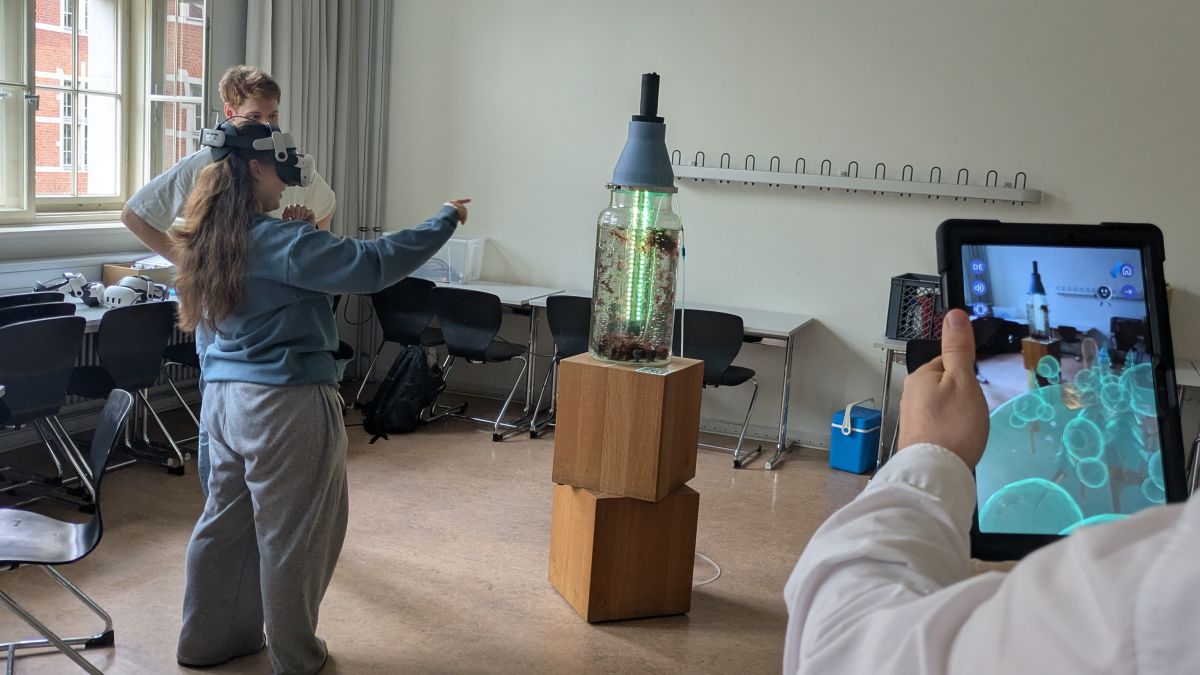
A roughly three-hour workshop held on June 3 at the Jane Addams School in Berlin-Friedrichshain addressed these questions. The morning session brought together academic insights, personal perspectives, digital tools, and hands-on experimentation. The goal was to provide students with an accessible yet academically sound introduction to potential food systems of the future.
Introduction to food4future
In a brief introduction, Leonhard Meitner presented the food4future research project and explained why questions about the future of food are no longer abstract: Climate change, urbanization, dwindling resources, and unstable supply chains show that food systems must be more resilient, more sustainable, and, at the same time, socially acceptable. food4future addresses this issue and explores how alternative food sources, new cultivation systems, and digital outreach formats can help us rethink food.
Creative Media and Science Communication
Martin Steinicke then provided an insight into the work of the Creative Media research group at HTW Berlin and, by extension, into the world of science communication. The discussion focused on technologies such as virtual reality, mixed reality, and interactive media, as well as on the question of how complex research can be communicated in a way that makes it tangible, open to discussion, and malleable. In addition to discussing the project, Martin Steinicke spoke about his own journey into game-based learning and how academic content, creative media practice, and personal experiences can be combined.
Algae as the Food of the Future
Dr. Anna Fricke, an algae expert at food4future, then provided a technical focus. In her presentation, she introduced the history and biology of algae and explained why this group of organisms is so exciting for the future of nutrition.
Algae are among the oldest life forms on Earth and have played a decisive role in shaping the development of our planet. Through photosynthesis, they contribute to oxygen production, sequester carbon, and form the basis of many food chains in aquatic ecosystems. Algae are of interest to researchers for several reasons: They do not require traditional farmland, can produce biomass very efficiently depending on the species, and contain valuable nutrients such as proteins, dietary fiber, minerals, pigments, and polyunsaturated fatty acids. In doing so, they open up new possibilities for food, sustainable raw materials, and innovative production systems.
Dr. Anna Fricke also made it clear that algae are not simply “the food of the future,” but must be considered on a case-by-case basis. Which species are suitable for which applications? How can they be cultivated safely, sustainably, and to a high standard of quality? What do they taste like, how are they processed, and how are they perceived by consumers?
Future Food Tasting: A Taste of the Future
After the presentations, the students were able to experience the food of the future firsthand: During the Future Food Tasting, they had the opportunity to discover new flavors, textures, and ingredients. Tasting the foods together proved to be a particularly important part of the workshop. After all, acceptance doesn’t come from information alone, but also from experience. What may sound unfamiliar at first can, when experienced directly, spark curiosity, break down prejudices, or raise new questions.
The Transition to the Digital Space
After a short break, the group moved on to the digital and immersive part of the workshop, which was led by Marino Gabel. During the hands-on phase of the workshop, the participants worked at four stations. Three of the stations were digital, while the fourth consisted of an analog Post-it wall where participants answered questions, shared their impressions, and visualized their thoughts.
Three Digital Stations – Three Perspectives on Future Foods
- Algae App: EcoSpire: The “EcoSpire” algae app allows users to explore key questions about sustainable food in a playful way: How are new foods produced? What resources are needed for this? And how do environmental conditions affect growth? Students go through four sequential phases, from seedling propagation to large-scale cultivation. In doing so, they adjust parameters such as light, temperature, and nutrient supply and directly observe how these decisions affect the growth of the macroalgae.
- VR Experience: Future Food: In this virtual reality application, participants immerse themselves in possible future food scenarios and explore the role that alternative organisms, such as macroalgae, jellyfish, or crickets, might play. In imaginative aquatic and terrestrial worlds, they navigate through various production environments, collecting nutrients such as proteins, vitamins, and antioxidants, thereby ensuring their own “shelf life.” In the process, they gain insights into urban indoor farming systems, vertical farming, and the new foods of the future.
- Mixed Reality Exhibit: Food Visions XR: The physical exhibit of the algae reactor was digitally enhanced using mixed reality. Additional layers of information illustrated how innovative cultivation systems work and the roles that technology, cycles, and design play in the future of food. With a simple gesture, the students immersed themselves in virtual worlds and explored three future scenarios. There, visitors could experience how algae and other food4future organisms could be cultivated, processed, and integrated into urban living spaces in the future.
Research on the Workshop Format
The workshop was structured around a questionnaire and an accompanying research project. The focus is on how this type of workshop format affects the acceptance of novel foods.
Special thanks go to everyone involved who made the on-site workshop possible and supported it, to the teacher at Jane Addams School, and to all the students who engaged with the topic in an open, curious, and critical manner.
Further information:
- Digital Tool Suite: Creative Media
- Macroalgae Project: Macroalgae Cultivation in food4future
- SolKuBim: Brine-based cultivation systems for freshwater macroalgae and microalgae